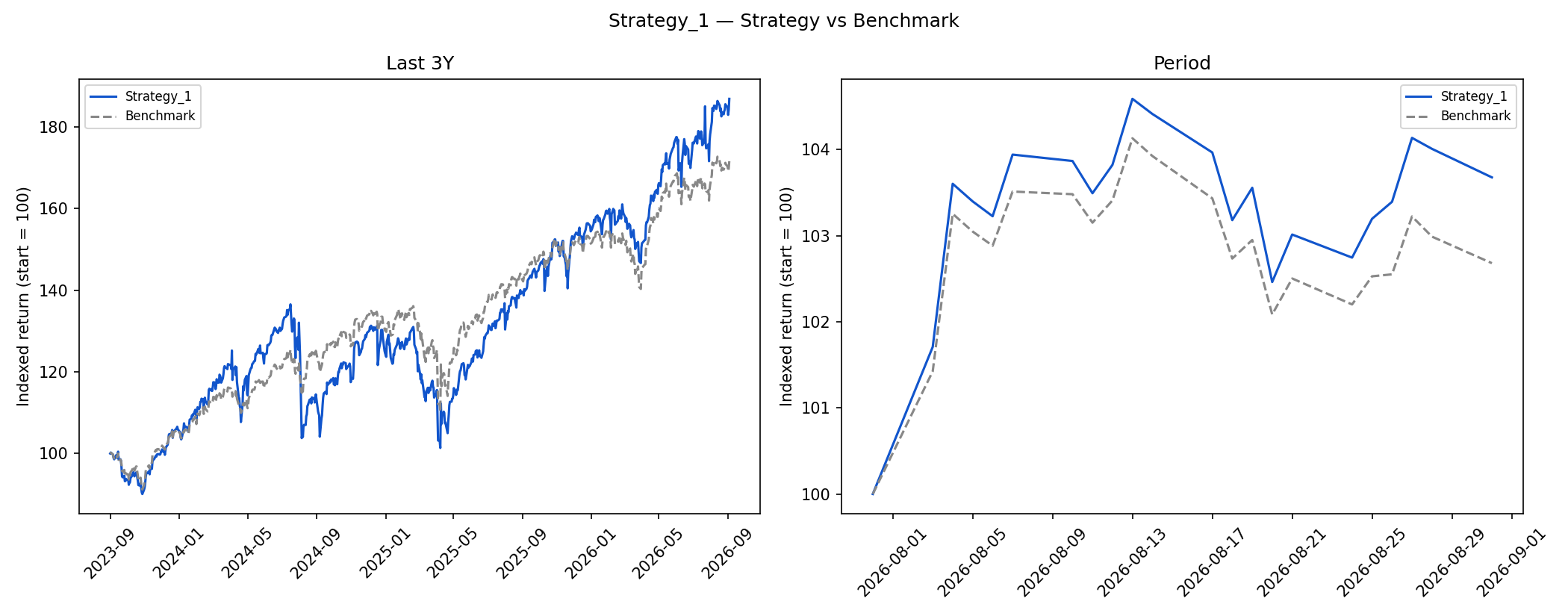
Defensive Premium Harvest: August 2026
The Defensive Premium Harvest strategy returned +2.57% in August, tracking the S&P 500's +2.68% gain to within –0.11% as a sustained, low-volatility equity rally left little room for the put-writing book to add above the index. The result is the expected behaviour of the strategy in its least favourable relative environment: when markets rise steadily and implied volatility sits near multi-year lows, the strategy participates almost fully in the upside while the income and hedge components mark time.
The Defensive Premium Harvest strategy returned +2.57% in August, fractionally behind the S&P 500's +2.68% gain and delivering –0.11% of underperformance — a negligible gap that reflects the specific mechanics at work in a strongly rising, low-volatility month. The strategy harvests the variance risk premium by writing S&P 500 puts while holding long VIX calls as a convex hedge, with a trend filter that remains fully engaged as long as the index trades above its long-horizon trend.
August's environment was mixed for this structure: a sustained equity rally is precisely the backdrop in which put premium is collected without assignment stress and the trend filter stays open, both positives. The headwind was the volatility regime. The VIX spent most of the month near 14 — its lowest level of 2026 — compressing the premium available on newly written puts and reducing the income contribution of the short-put book relative to simply holding the index.
The VIX-call hedge also bled carry in the calm environment, a persistent theta cost that weighs on relative returns in low-volatility stretches. The result is characteristic: in a strong up month with compressed implied volatility, the strategy tracks the index closely rather than outperforming it.
Talking points
- The strategy delivered a strong absolute return in August, participating almost fully in a market that posted its best August since 2021. The trend filter remained active throughout, keeping the full put-writing programme in place as the S&P 500 advanced — so clients captured the majority of the index's upside while the income component continued to compound. A –0.11% gap relative to the benchmark in a month of this strength is consistent with the strategy's design.
- August's unusually low volatility environment was the main reason the strategy didn't outperform the index, not any failure of its mechanics. When the VIX trades near 14-year lows, the premium available on new put positions is thinner, and the long VIX-call hedge costs carry without benefiting from a spike. Both effects are well understood features of a low-fear market — and they reverse when volatility normalises.
- Clients should understand that this strategy earns its return advantage over time, not in every individual month. Months when equities rally hard and volatility stays compressed tend to see the strategy track the index rather than beat it; months featuring volatility events or drawdowns are when the combined put-income and VIX hedge structure earns its keep. The August result is a reminder that strategy performance and benchmark outperformance are different things — and that a +2.57% return in a calm month is a sound outcome in absolute terms.