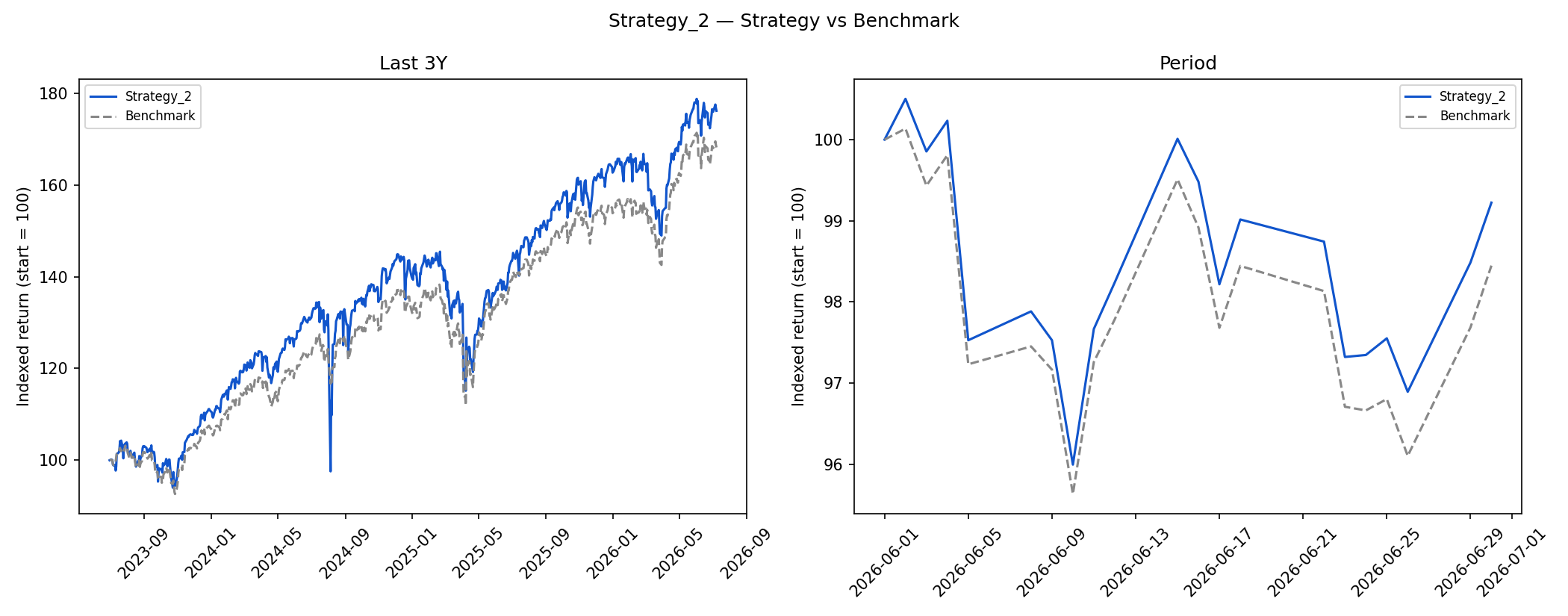
Diagonal Volatility Carry: June 2026 Performance
The Diagonal Volatility Carry strategy posted a –0.85% return in June, outperforming the S&P 500 by +0.43% as the book's dynamic risk engine scaled down exposure in response to the month's hawkish policy surprise and resulting volatility uptick. The result demonstrates the strategy's risk discipline in action: when conditions turn hostile for short-volatility positions, the sizing mechanism limits damage rather than compounding it.
June delivered a genuinely challenging environment for the Diagonal Volatility Carry strategy, and a loss of –0.85% on the month reflects that honestly. The strategy is structurally net-short volatility via a VIX call ratio — collecting premium as implied volatility decays toward realised levels — and the hawkish FOMC meeting on 17 June was a textbook headwind for this posture. Warsh's first decision as Fed Chair, a hold accompanied by a dot plot tilting toward a December hike and a materially higher PCE forecast, injected genuine policy uncertainty and pushed the VIX from subdued mid-month levels to finish the month near 17–18. That directional move in the VIX compressed, though did not eliminate, the premium decay the structure depends on.
Critically, the book's risk engine performed its intended role: as the volatility environment turned more hostile, sizing was scaled down, containing the loss to a level that compared favourably against the S&P 500's own decline of –1.28%. The cross-asset backdrop — crude's near-20% collapse, gold's 11% drawdown, and EUR/USD compression — was largely orthogonal to the strategy's mechanics, but it reinforced the equity uncertainty that supported the VIX's elevated close. The +0.43% of outperformance against benchmark is a modest but meaningful read on the risk discipline: the strategy did what it should when conditions soured, limiting damage rather than compounding it.
Talking Points
- The strategy delivered its intended defensive behaviour in a difficult month. June's unexpected hawkish turn from the Federal Reserve pushed volatility higher and compressed the premium income the strategy collects — an environment squarely in the "unfavourable" column. Despite that, the strategy's dynamic risk engine reduced position sizes as conditions deteriorated, and the result was a loss materially smaller than the broader S&P 500 index.
- Outperforming the index by 0.43% during a policy shock is the clearest evidence that active risk management adds real value. A passive index holding bore the full brunt of rate-hike repricing and dollar strength in June; this strategy did not. The sizing discipline — which steps down exposure automatically when the volatility environment turns hostile — is precisely the mechanism that produced that gap.
- Clients should understand that the strategy carries an uncapped tail in extreme volatility events, and June was a reminder of why that risk must be sized carefully. The VIX move this month was meaningful but not extreme; in a sharper spike, the net-short structure would face greater pressure. The risk framework is designed to manage that exposure actively, not eliminate it — and June is a clean example of it working as described.