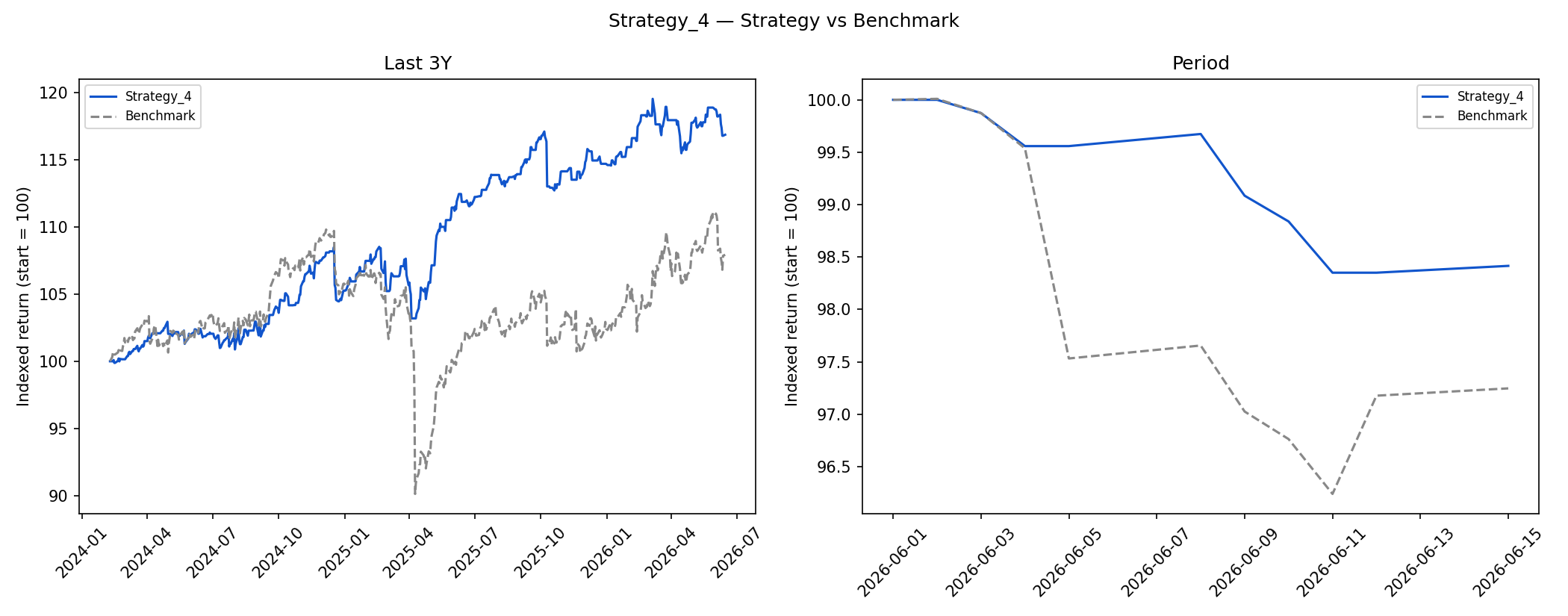
Predictive Gamma Strategy: June 2026 performance
The Predictive Gamma Strategy returned –1.70% in June, outperforming its benchmark — the daily short 0DTE straddle — by +1.18% as the ML classifier successfully identified and avoided the high-uncertainty sessions that made June particularly costly for undiscriminating short-volatility approaches. The result is a direct demonstration of the strategy's core edge: not the return earned on days it traded, but the losses avoided on the days it chose not to.
June was a loss-making month for the Predictive Gamma Strategy, returning –1.70%, but that figure requires context: the strategy's benchmark — selling a 0DTE S&P 500 straddle every session without discretion — lost –2.88% over the same period, leaving the strategy +1.18% ahead of the naïve alternative. That gap is precisely where the strategy's value proposition lives. The ML classifier, which ingests over 30 live features including VIX/VIX1D ratios, VVIX momentum, and realised-versus-implied move spreads, issues a daily Long, Short, or Flat signal — and June's environment generated exactly the kind of sessions where standing aside is the correct trade.
The hawkish FOMC meeting on 17 June was a textbook example: a policy surprise that drove an outsized intraday move in the S&P 500 would have delivered a sharp loss to any undiscriminating straddle seller that day, while the model's filters are specifically designed to identify elevated-uncertainty sessions and issue a Flat signal rather than commit capital. The VIX averaging 16.41 and finishing near 17–18 describes a month with pockets of genuine intraday dislocation rather than the steady, low-realised-volatility grind in which the strategy earns most cleanly. The –1.70% loss reflects the real cost of those dislocation days where the model did engage; the +1.18% of outperformance reflects how many of the worst sessions it successfully avoided.
Talking points
- The strategy's core discipline — knowing when not to trade — delivered its clearest benefit in June. A month punctuated by a major policy surprise from the Federal Reserve produced exactly the kind of sharp, unpredictable intraday moves that destroy returns for mechanical straddle sellers. By standing aside on the days its model flagged as high-uncertainty, the strategy avoided the worst of that damage and outperformed the benchmark of selling every day by over one percentage point.
- Clients should understand that the benchmark here is not the S&P 500 index — it is the far more demanding standard of selling a 0DTE straddle every single session. That brute-force approach lost –2.88% in June, a reminder of the tail risk embedded in undiscriminating short-volatility strategies. The strategy's –1.70% loss, while real, reflects selective engagement: capital was only committed on days where the model identified a statistically elevated edge, not indiscriminately across every session.
- A loss month that still outperforms benchmark by +1.18% is the intended behaviour of a disciplined, signal-driven strategy in a noisy environment. The goal is not to win every month — some months, like June, will produce losses when intraday volatility is elevated and unpredictable. The goal is to win meaningfully more than the alternative over time, and the June result is consistent with that objective: the model filtered out enough losing sessions to deliver a materially better outcome than the default approach.