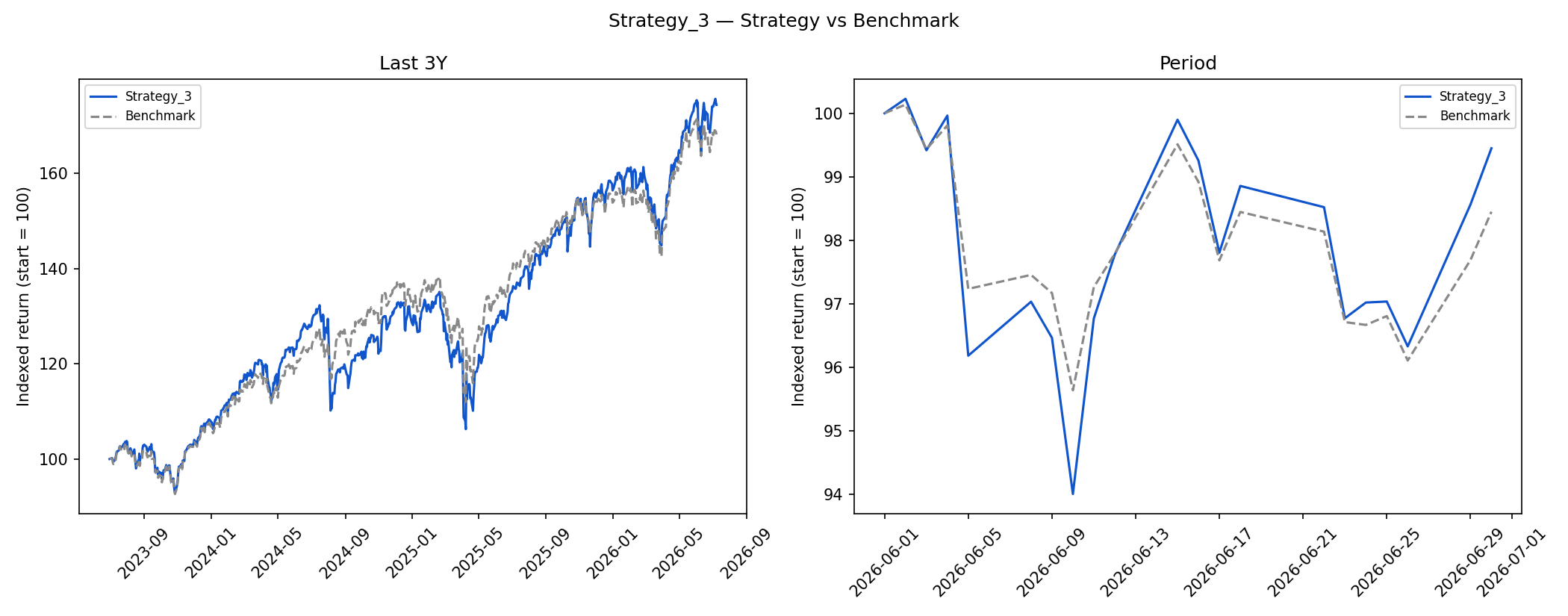
Systematic Surface Capture: June 2026 performance
The Systematic Surface Capture strategy held up strongly in June, returning –0.28% against a –1.28% benchmark decline and delivering +1.00% of outperformance as premium collected across both the skew and term structure of the volatility surface cushioned the impact of a rate-repricing shock. The result reflects the strategy's dual-axis design at work: two independent sources of income, neither dependent on market direction, combining to deliver a materially smoother outcome than the index.
June proved a relatively constructive month for the Systematic Surface Capture strategy, with a loss of just –0.28% against a benchmark decline of –1.28%, delivering +1.00% of outperformance. The strategy harvests two distinct inefficiencies across the S&P 500 volatility surface — the structural overpricing of upside call protection and the accelerated decay of short-dated put premium — and June's environment proved broadly supportive of both. The VIX, averaging 16.41 and finishing near 17–18, sat in a range that kept implied volatility elevated enough to provide meaningful premium on the calls written, while the S&P 500's modest 1–2% decline meant the index drifted lower without the kind of sharp, sustained sell-off that would stress the net-short put ratio leg.
The hawkish FOMC surprise on 17 June did inject intraday volatility, and the trend discipline that trims exposure as the market weakens would have reduced the book's directional footprint around that event — containing the downside at the cost of some premium left on the table. The collapse in crude and gold was largely orthogonal to the strategy's mechanics, but softer commodity prices reinforced the absence of the inflationary breakout scenario that would drive the sharp equity rally the short-call leg is most exposed to. The outcome — outperforming the index by a full percentage point while remaining net-short — is a clean demonstration of the dual-axis VRP capture working across both skew and term structure simultaneously.
Talking points
- The strategy significantly cushioned investors against a difficult month for equities, losing just a fraction of what the S&P 500 index lost. By generating income from two independent sources — overpriced upside protection and the faster decay of short-dated put premium — the strategy did not rely on the market going up to deliver that outcome. The +1.00% of outperformance against the index came from the mathematical passage of time working in the strategy's favour, not from a directional call on markets.
- The month's sharp macro surprise — a hawkish Fed pivot on 17 June — was absorbed without meaningful damage, illustrating how the strategy's trend discipline works in practice. When equity markets came under pressure following the FOMC meeting, the book's exposure was automatically trimmed, reducing the net-short put position that would otherwise carry the most downside in a falling market. That dynamic adjustment is a core feature of the strategy, not a one-off decision.
- Clients should be aware that this strategy carries genuine downside risk in two specific scenarios: a sharp, sustained equity rally, and a violent volatility regime shift. The short upside call leg loses money if the S&P 500 surges strongly, and the net-short put ratio is not fully hedged against a severe drawdown. June avoided both of those conditions, which is a key reason the strategy outperformed — but understanding those tail scenarios is essential context for the strong month-on-month result.