Systematic Surface Capture: July 2026
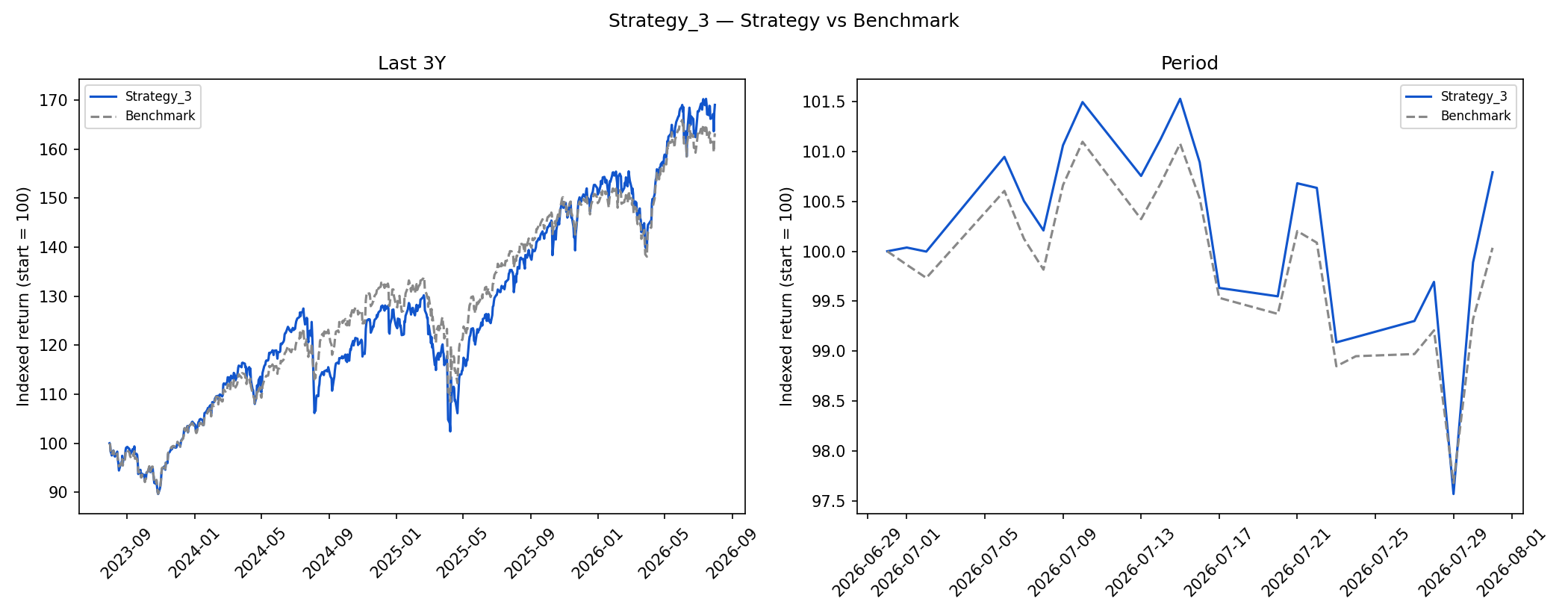
The Systematic Surface Capture strategy returned +0.79% in July, outperforming the benchmark by 76 basis points as both axes of the strategy contributed in a month where the S&P 500 went essentially nowhere. Overpriced upside call premium decayed fully as the market drifted lower, while the term-structure put ratio benefited from a persistently wide variance risk premium and a trend filter with no reason to reduce exposure. July was a clean illustration of how harvesting premium across two independent dimensions of the volatility surface can generate consistent returns regardless of equity market direction.
Systematic Surface Capture returned +0.79% against a benchmark of +0.03%, outperforming by 76 basis points, and July's environment illustrated precisely why the strategy's dual-axis construction adds diversification value relative to single-leg premium programs.
The first axis — systematically writing short-dated out-of-the-money calls to monetise the structural overpricing of upside crash-up protection — was well-rewarded: the S&P 500 declined modestly and the semiconductor-driven selloff left the broad index's upside firmly unchallenged, meaning those calls expired with maximum decay.
The second axis — the net-short put ratio across tenors — operated in a more nuanced environment: the wide VRP (VIX at 17.09, realised volatility at 11.9%) supported front-tenor premium collection, and while mid-month volatility spikes created intra-period pressure on the short put leg, the longer-dated protective leg partially absorbed regime-shift risk, and the trend filter had no cause to reduce exposure as the index held above its long-horizon trend throughout. The VaR-based sizing engine, which calibrates to the book's combined net risk rather than any individual leg, kept overall exposure commensurate with the environment. A month where both axes contributed and the strategy's structural breadth — harvesting skew and term structure simultaneously — delivered meaningfully ahead of a flat benchmark.
Talking points
- The strategy generated nearly 0.8% return in a month where the market went nowhere. By harvesting premium across two distinct dimensions of the options market — overpriced upside protection and time-decay imbalances across contract maturities — the strategy produced a differentiated return stream that had little to do with the direction the S&P 500 moved.
- A sharp technology selloff, counterintuitively, supported one of the strategy's key positions. The strategy systematically sells short-dated call options on the S&P 500. With the market declining modestly in July, those positions expired with full time decay intact — demonstrating how the strategy can benefit from periods of equity weakness or stagnation that frustrate traditional long-only investors.
- The strategy's dual approach means it is not dependent on any single market condition being right. Unlike strategies that harvest premium from only one source, this approach extracts value from both the overpricing of extreme upside insurance and the structural decay advantage of shorter-dated contracts — two forces that tend to persist across different macro regimes.